Across Fort Wayne, Indiana—from the towering three-story Victorian and Craftsman residences in historic West Central (46802) and Southwood Park (46807) to the sprawling two-story colonials and modern builds in Aboite Township (46804) and North Fort Wayne (46845)—the residential attic is frequently the most inaccessible, hazardous, and neglected storage area in the home. Accessed through narrow pull-down wooden ladders, steep attic staircases, or tiny ceiling crawl hatches, attics accumulate decades of forgotten holiday decorations, vintage trunks, old luggage, broken heirloom furniture, boxed paperwork, and leftover construction materials. Junk Harbor provides specialized, full-service overhead attic cleanout solutions across Fort Wayne and Allen County, conquering tight access hatches, extreme roof-cavity temperatures, and hazardous ceiling joists to safely clear your attic without property damage.
In Northeast Indiana, executing a DIY attic cleanout is fraught with severe physical danger and structural vulnerability. Most residential attics are unconditioned, unfinished spaces where the floor consists solely of exposed wooden ceiling joists spaced 16 to 24 inches apart, surrounded by loose blown-in cellulose or thick fiberglass batt insulation. A single misstep off an exposed wooden rafter causes your foot to punch directly through the plaster or drywall ceiling below, creating thousands of dollars in structural ceiling damage and severe personal injury risks. Furthermore, during Indiana’s humid summer months, attic temperatures routinely surge past 125°F, creating extreme thermal exhaustion and dehydration hazards, while old fiberglass insulation releases microscopic glass fibers into the air that cause intense dermal and respiratory irritation. Junk Harbor eliminates every danger: our trained, fully insured removal specialists wear professional PPE respirators, lay down temporary load-bearing walking boards across open joists, utilize controlled rope-and-pulley bucket systems, and carefully extract every piece of overhead clutter down into our trucks, followed by comprehensive floor and stairway cleanup.
- Joist Navigation & Fall-Through Prevention: Our crew utilizes temporary plywood walking planks and structural load distribution platforms to prevent drywall damage.
- Full PPE & Respiratory Safety: Equipped with N95/P100 respirators, protective eye gear, and gloves to handle aged fiberglass dust and rodent droppings safely.
- Controlled Bucket & Pulley Extraction: Fragile items, vintage trunks, and small boxes are lowered safely through narrow attic hatches without dropping or scattering debris.
- 100% Eco-Friendly Recycling & Donation: Usable vintage goods, antiques, and books are routed to Fort Wayne charity partners; recyclable metals are delivered to local scrap processors.
Is Your Fort Wayne Attic Packed with Decades of Overhead Clutter?
Do not risk falling through your ceiling or suffering heat exhaustion. Let Junk Harbor’s trained specialists clear your attic safely!
The Extreme Dangers, Structural Hazards & Thermal Perils of Overhead Attic Cleanouts
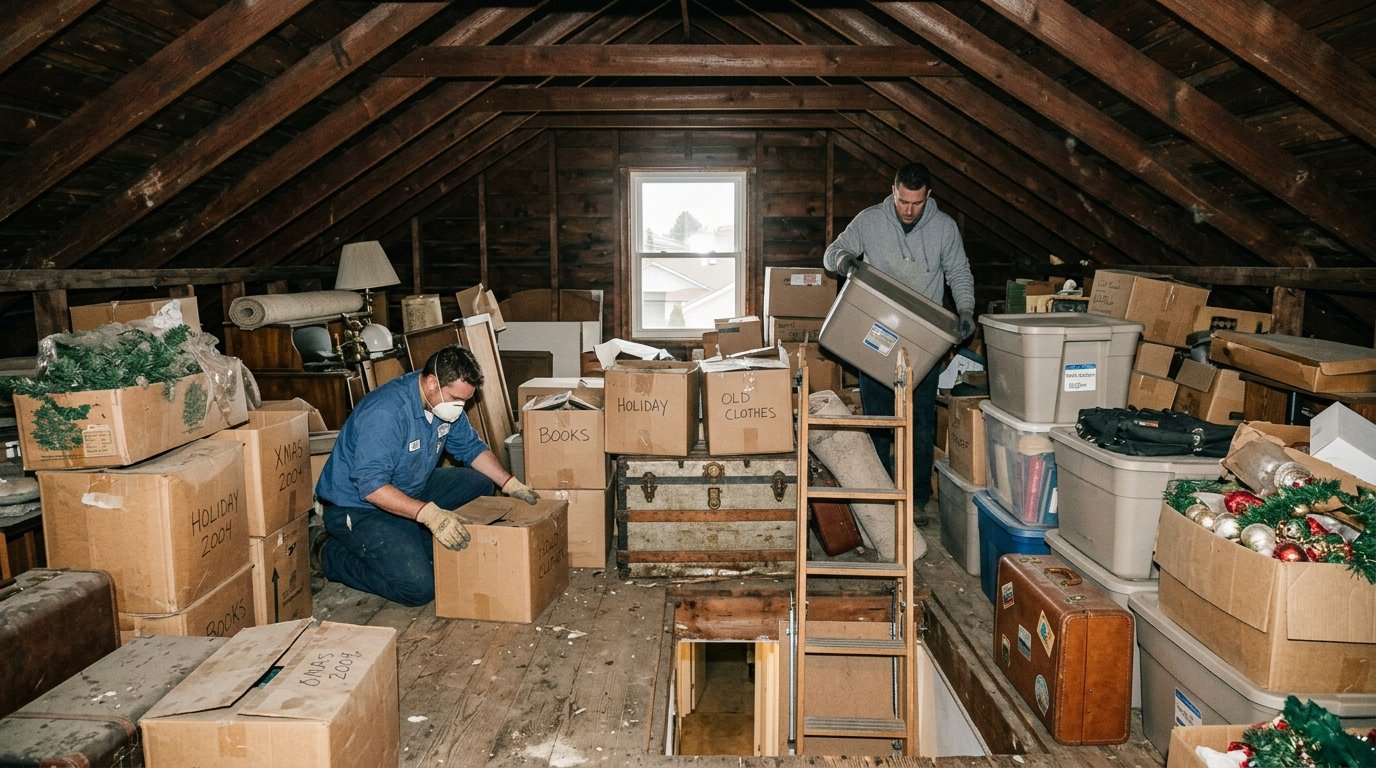
Attics are among the most structurally treacherous zones in residential construction. Attempting a DIY cleanout without professional equipment and biomechanical training exposes homeowners to high-risk hazards that can cause catastrophic property damage and severe bodily harm.
1. The Fall-Through Hazard: Open Ceiling Joists & Drywall Failure
In unfinished attics, there is no solid subfloor. The visible floor between joists is merely 1/2-inch drywall or historic wood-lath plaster designed solely to support its own weight and paint. When a homeowner carrying a heavy storage box loses balance or misjudges their footing, their entire body weight concentrates on the drywall, punching a gaping hole through the ceiling into the bedroom or hallway below. Repairing a blown-out drywall ceiling requires expensive framing repair, drywall hanging, taping, mudding, texture matching, and painting the entire ceiling plane. Junk Harbor technicians lay down 3/4-inch structural plywood walkways before lifting any heavy objects, creating a secure, continuous walking platform across roof rafters.
2. Thermal Stress & Heat Exhaustion Risks
Due to solar radiant heat absorption through roof asphalt shingles, unventilated roof cavities in Fort Wayne quickly turn into ovens from late spring through early autumn. Working in 120°F+ temperatures while lifting heavy boxes induces rapid dehydration, dizziness, muscle cramping, and heat stroke. Dizziness on an open joist significantly increases the risk of falling through the ceiling. Our crews work in rotating hydration shifts, bring portable industrial ventilation blowers, and utilize high-output LED work lights to ensure safe, temperature-managed operations.
3. Airborne Fiberglass Dust & Biohazard Contaminants
Disturbing decades-old attic storage stirs up dense clouds of microscopic fiberglass particles, rock wool dust, and cellulose fibers that settle deep into the lungs and cause severe throat and eye inflammation. Additionally, attics frequently harbor bat guano (which can carry histoplasmosis fungal spores), squirrel nests, raccoon latrines, and mouse droppings. Inhaling aerosolized rodent droppings exposes individuals to dangerous pathogens like hantavirus. Our specialists wear sealed P100 particulate respirators, full protective Tyvek suits, and heavy-duty nitrile-coated gloves to isolate and bag biohazardous materials safely.
Exhaustive Attic Material Classification & Handling Matrix
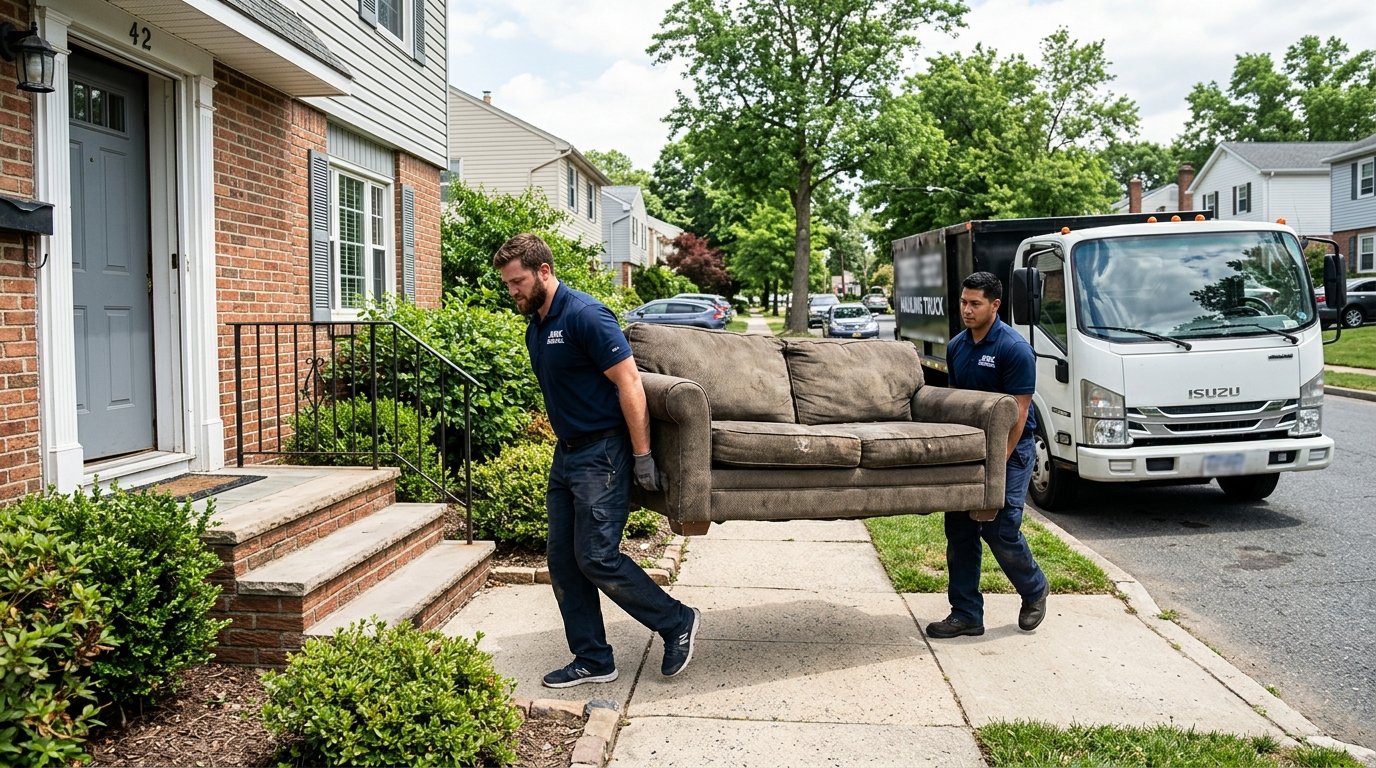
Attics shelter a unique assortment of lightweight seasonal goods, heavy antique heirlooms, and deteriorated building insulation. Our sorting matrix ensures maximum salvage value and safe disposal:
| Attic Item Classification | Standard Examples & Sub-Categories | Avg. Weight Range | Recycling / Donation Potential | Handling & Lowering Protocol |
|---|---|---|---|---|
| Vintage Furniture & Trunks | Cedar chests, steamer trunks, antique wooden rocking chairs, vanity dressers, vintage hatboxes | 35 – 180 lbs | 85% Antique Salvage / Donation (High demand at local Fort Wayne thrift stores) | Secured with lowering ropes through attic hatch; passed down to staging team on floor below. |
| Boxed Paperwork, Books & Photos | Cardboard banker boxes, vintage magazines, photo albums, school yearbooks, old tax records | 15 – 45 lbs per box | 90% Fiber Recycling / Shredding (Confidential shredding or paper pulping) | Inspected for heirlooms; passed down sequentially via two-man bucket-brigade line. |
| Seasonal & Holiday Decor | Artificial Christmas trees, holiday ornament totes, wreath boxes, lawn inflatables, Halloween decor | 10 – 35 lbs | 70% Charitable Donation (Community holiday programs, non-profit thrift) | Tightly grouped into large transport bins; loaded for direct donation sorting. |
| Deteriorated Insulation Batts & Scrap | Fallen fiberglass batt insulation, cellulose debris, old building lumber scraps, roofing cutoffs | Variable | Special Solid Waste Disposal (Allen County Transfer Station) | Bagged in heavy 3-mil contractor bags directly inside attic; sealed to prevent airborne dust dispersion. |
| Outgrown Luggage & Sporting Gear | Hard-shell suitcases, garment bags, vintage skis, baseball gear, camping tents, sleeping bags | 10 – 30 lbs | 80% Donation to Local Shelters (Rescue Mission, youth recreational clubs) | Inspected for condition; loaded for direct delivery to Fort Wayne non-profit partners. |
The Step-by-Step Complete Attic Cleanout Protocol
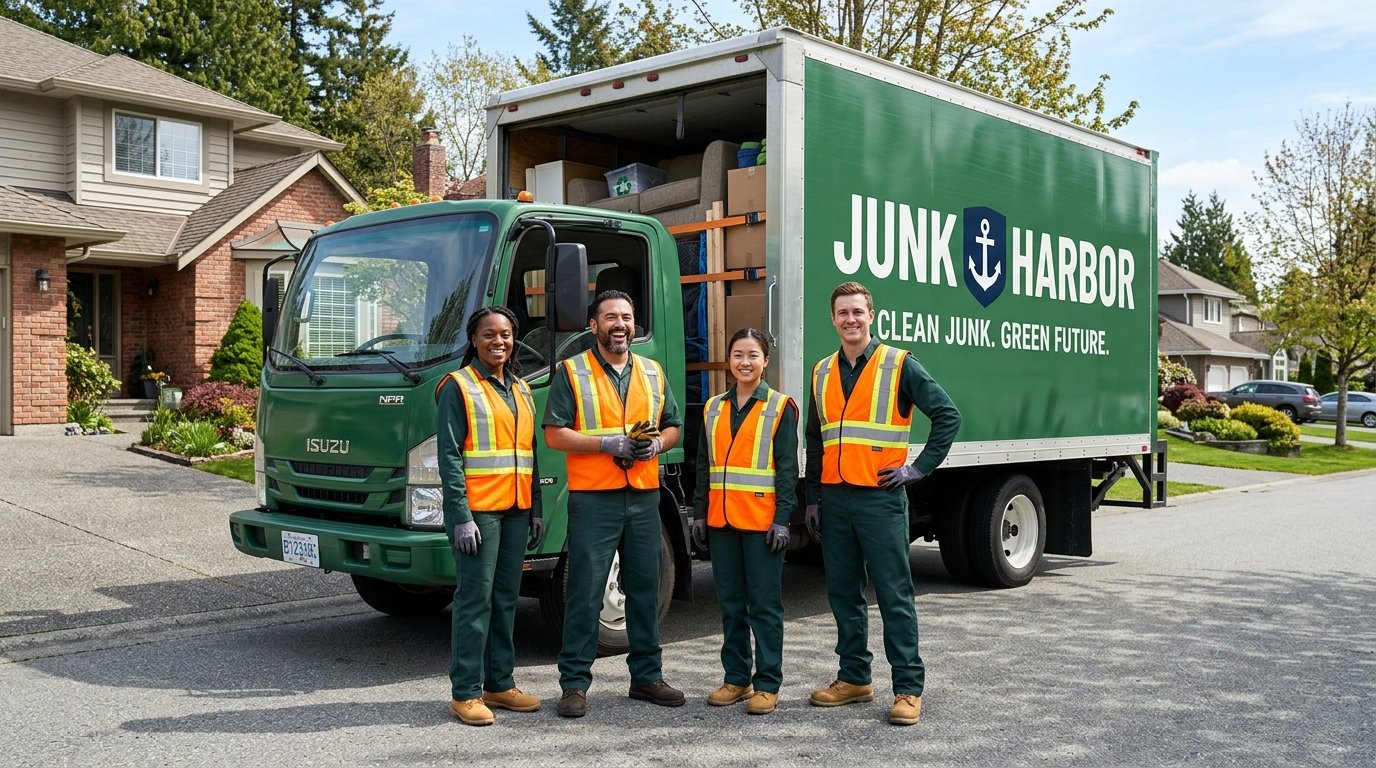
Junk Harbor executes attic cleanouts using a disciplined, four-phase standard operating procedure designed to eliminate fall risks, contain insulation dust, and protect your home’s living spaces:
Phase 1: Pre-Cleanout Inspection, Hatch Survey & Flat Quote
- Punctual Arrival & ETA Notification: Our two-man crew arrives on schedule, calling you 20 minutes prior to arrival.
- Attic Entry & Structural Assessment: We inspect the attic access point (pull-down ladder, scuttle hole, or stairway) and assess joist integrity and lighting conditions.
- Guaranteed Upfront Flat Quote: We provide an all-inclusive, binding flat rate covering all labor, protective boarding, lowering rigging, and disposal fees.
Phase 2: Walkway Installation & Indoor Pathway Containment
- Protective Floor Runner Deployment: We lay down non-slip neoprene floor runners from the attic hatch through hallways and down stairways to our truck.
- Drywall & Doorjamb Protection: We protect doorjambs and trim surrounding the attic access hatch with high-density foam padding.
- Plywood Walkway Installation: Our technicians position 3/4-inch structural plywood planks across exposed ceiling joists to establish a 100% safe walking and staging platform.
Phase 3: Controlled Lowering & Sequential Extraction
- Two-Man Bucket-Brigade Lowering: One technician inside the attic passes items down to the receiving technician stationed below on the ladder or landing.
- Rope & Pulley Rigging for Heavy Trunks: Heavy vintage trunks, solid wood dressers, and large furniture are lowered using controlled friction ropes to eliminate drop hazards.
- High-Density Truck Packing: Items are packed tightly into our 16-foot box truck to ensure maximum volume efficiency and cost savings for you.
Phase 4: Vacuuming, Magnetic Sweeping & Final Walkthrough
- Floor & Stairway Vacuuming: We vacuum any stray insulation dust, cellulose fibers, or debris that escaped during the lowering process from carpets and hardwood floors.
- Driveway Magnetic Sweeping: We roll high-intensity magnetic sweepers across your driveway to ensure no nails or hardware remain.
- Final Inspection & Sign-Off: You inspect the cleared area with our lead technician before processing payment via credit card, check, or cash.
Eco-Friendly Donation, Antique Salvage & Recycling in Fort Wayne

Attics frequently hold vintage treasures, antique furnishings, and historical goods that deserve a second life. Junk Harbor prioritizes local donation and material reclamation across Allen County:
- Habitat for Humanity ReStore (Fort Wayne): Vintage doors, architectural hardware, light fixtures, and solid wood furniture are donated to support local affordable homebuilding.
- Fort Wayne Rescue Mission & Local Shelters: Usable luggage, winter coats, blankets, and clean household linens are delivered to support individuals in emergency housing programs.
- Certified Allen County Metal Foundries: Old metal trunks, bed frames, and metal holiday stands are routed to local scrap foundries for 100% recycling.
Neighborhood Attic Service Coverage Across Fort Wayne & Surrounding Counties

Our hauling fleet covers every residential neighborhood across Allen, DeKalb, Whitley, and Kosciusko Counties:
- Historic Central Fort Wayne (46802, 46805, 46807): Multi-story Victorian and Craftsman attics in West Central, Southwood Park, and Lakeside with steep stairs and large third-floor attic rooms.
- Southwest Fort Wayne & Aboite Township (46804, 46814): Two-story colonial attics, scissor-truss modern attics, and bonus room storage areas.
- North Fort Wayne (46825, 46835, 46845): Dupont, Coldwater, Maplecrest, and Pine Valley residential attic decluttering.
- New Haven (46774), Huntertown (46748) & Leo-Cedarville (46765): Suburban attics, garage lofts, and barn storage liquidations.
- Auburn (46706), Columbia City (46725) & Warsaw (46580): Complete attic cleanouts across regional homes and lakefront properties.
Transparent Attic Cleanout Pricing & Cost Breakdown

Our attic cleanout pricing is based strictly on the total volume space occupied in our 16-foot box truck, with all labor, safety boarding, lowering rigging, and disposal fees included:
| Cleanout Scope | Approximate Volume | Typical Included Items | Estimated Pricing |
|---|---|---|---|
| Minor Attic Declutter | 1/8 to 1/4 Truckload (2–4 cu. yds) | 8-12 boxes of holiday decor, vintage luggage, small table | $165 – $265 |
| Half-Attic Cleanout | 1/4 to 1/2 Truckload (4–8 cu. yds) | Vintage trunks, 20-30 boxes, holiday tree, small dresser, luggage | $295 – $465 |
| Substantial Attic Cleanout | 1/2 to 3/4 Truckload (8–13 cu. yds) | Full attic clearing with furniture, trunks, paperwork, seasonal decor | $495 – $645 |
| Full Whole-Attic Hoard / Historic Estate | Full Truckload+ (16–24+ cu. yds) | Massive third-floor Victorian attic packed with decades of accumulation | $745 – $1,150+ |
Comprehensive Extended FAQ Section: Attic Cleanouts
1. Do I need to climb into the attic or carry boxes down before you arrive?
No! Our full-service crew enters your attic, lays walking boards across the joists, handles all lowering, and carries everything directly out to our truck. You do not need to enter the attic.
2. How do you prevent stepping through the drywall ceiling?
Our technicians lay down 3/4-inch structural plywood planks across exposed joists to create secure walking and staging platforms, completely eliminating the risk of stepping through ceiling drywall.
3. How do you get heavy items down through small attic pull-down ladders or scuttle holes?
We utilize controlled rope-and-pulley lowering systems and synchronized two-man bucket brigades, passing items carefully through the hatch to a crew member on the landing below.
4. Will insulation dust spread through my home during the cleanout?
No. We bag insulation scraps in sealed heavy-duty contractor bags inside the attic, lay floor protection runners throughout your hallways, and vacuum all landings and carpets thoroughly after extraction.
5. Can you clear attics in the middle of summer when it is very hot?
Yes. Our teams bring industrial ventilation blowers, work in rotating hydration shifts, and utilize specialized lightweight gear to safely clear hot attics during Indiana summer heatwaves.
6. What happens if you find antique family heirlooms or vintage valuables?
Our crew members are trained to immediately set aside any discovered family photographs, heirlooms, jewelry, vintage documents, or cash and deliver them directly to you.
7. Can you remove old bats, pests, or bird nests from the attic?
We can safely bag and dispose of old nesting debris and soiled insulation using full PPE respirators. For active bat colonies or live wildlife removal, we can recommend top local licensed wildlife control specialists.
8. Are you insured in case an accident occurs during the attic cleanout?
Yes. Junk Harbor carries full $2,000,000 General Commercial Liability Insurance and Indiana Workers’ Compensation coverage, fully protecting your home and property.
9. How long does a typical attic cleanout take?
Most standard residential attic cleanouts in Fort Wayne are completed in 2 to 4 hours by our experienced two-man team.
10. What items do you donate from attic cleanouts?
We donate clean vintage furniture, usable luggage, holiday decor, and books to local Fort Wayne non-profit partners like the Habitat ReStore and Rescue Mission.
11. What payment methods are accepted?
We accept all major credit cards, debit cards, cash, contactless payments, and personal/corporate checks upon job completion.
12. How do I get an estimate for my attic cleanout?
Call our local Fort Wayne office or submit a request on our Contact Us page. We provide free on-site quotes with guaranteed upfront pricing.
Clear Your Overhead Attic Safely & Easily Today!
Contact Junk Harbor for fast, professional attic cleanout services across Fort Wayne, IN.
Historic Roof Truss Architecture & Roof Cavity Preservation in Fort Wayne
Historic residences in Fort Wayne’s heritage neighborhoods—such as the Queen Anne Victorians in West Central and the English Tudors in Southwood Park—feature complex roof framing systems with steep pitches, intersecting gables, dormers, and massive timber rafters. These historic roof structures require specialized structural awareness during an attic cleanout:
1. Identifying Load-Bearing Collar Ties vs. Decorative Rafters
In older homes, horizontal collar ties and purlins provide vital lateral stability to the roof rafters under heavy Indiana winter snow loads. Unqualified individuals attempting cleanouts sometimes saw through or step heavily on collar ties to create more storage headspace, severely compromising the roof’s structural integrity. Junk Harbor specialists never alter, cut, or stress structural framing members.
2. Preserving Historic Lath and Plaster Ceilings
Plaster ceilings in historic Fort Wayne homes are anchored to the underside of ceiling joists by wooden lath and plaster “keys.” Vibration, excessive foot traffic, and heavy point-loading from stepping between joists can fracture these delicate plaster keys, causing entire ceiling sections in the rooms below to detach and collapse. Our technicians distribute load weight evenly using specialized load-spreading platforms, ensuring zero stress is transferred to historic plaster ceilings.
Attic Insulation Upgrades & Energy Efficiency Blueprints
An overfilled, cluttered attic severely restricts air circulation and compresses insulation, driving up heating and cooling utility bills. In Northeast Indiana, where winter heating costs and summer air conditioning demand are substantial, clearing out attic junk unlocks major home energy improvements:
- Eliminating Insulation Compression: Heavy storage boxes and furniture placed on top of fiberglass batt or cellulose insulation compress the air pockets within the material, reducing its thermal resistance (R-value) by up to 60%. Removing the clutter allows insulation to expand back to its optimal thermal loft.
- Air-Sealing Attic Bypass Holes: With the attic floor cleared, homeowners can easily locate and seal air leaks around chimney flues, recessed can lights, electrical wiring penetrations, and plumbing vent stacks using expanding foam sealant, preventing expensive conditioned air from escaping into the unconditioned roof cavity.
- Upgrading to Modern R-49+ Insulation Standards: Building codes in Northeast Indiana recommend R-49 to R-60 attic insulation (approximately 16 to 20 inches of blown cellulose or fiberglass). Clearing out old junk allows modern insulation contractors to blow in fresh, energy-efficient insulation seamlessly.
Professional Wildlife & Bat Guano Remediation Protocols
Attics in Northeast Indiana frequently serve as roosting sites for big brown bats and little brown bats, as well as squirrels and raccoons. While active bat colonies are protected under state wildlife laws during maternity seasons, abandoned attics frequently contain thick accumulations of bat guano and rodent droppings. Inhaling dust from dried bat guano can cause histoplasmosis, a serious lung infection caused by fungal spores. Junk Harbor technicians wear sealed P100 HEPA respirators, use HEPA-filtered industrial extraction vacuums, and treat contaminated areas with broad-spectrum antimicrobial sanitizers, leaving your roof cavity safe and clean.
DIY vs. Professional Attic Cleanout: Safety & Fall Prevention Audit
Navigating unfinished roof rafters while carrying bulky storage boxes poses severe fall-through risks. Evaluating a DIY attic cleanout against Junk Harbor’s professional overhead service highlights the critical safety protections:
| Safety & Operational Aspect | DIY Overhead Attic Attempt | Junk Harbor Professional Service |
|---|---|---|
| Fall-Through Prevention | High risk of stepping off joists through ceiling drywall | Zero Risk (3/4-inch structural plywood walkways deployed) |
| Respiratory Protection | Inhaling microscopic fiberglass dust and bat/rodent droppings | Full PPE (Sealed P100 HEPA respirators & protective suits) |
| Heat & Thermal Exhaustion | Dangerous exposure to 120°F+ attic temperatures | Managed (Industrial ventilation blowers & rotating crew shifts) |
| Lowering Heavy Trunks & Items | Risk of dropped items breaking or pulling down ladders | Controlled Rigging (Rope-and-pulley & two-man bucket brigades) |
| Post-Cleanout Dust Management | Insulation dust settles throughout home living areas | Contained (Plastic hatch containment & HEPA vacuuming) |
Historic Attic Renovation & Loft Conversion Preparation
Many homeowners in Fort Wayne’s historic districts (such as West Central and Southwood Park) choose to convert expansive third-story attics into master suites, home offices, or artist studios. Clearing decades of accumulated storage, old framing cutoffs, and deteriorated insulation is the vital first phase of any attic conversion project. Junk Harbor provides complete pre-renovation cleanouts, stripping the attic down to the bare roof rafters and floor joists so architects and framing contractors can inspect structural timbers and begin electrical and HVAC rough-ins.
Extended Attic Cleanout FAQs (Continued)
17. Can you clean out attics in homes with steep, narrow spiral staircases?
Yes. Our team has extensive experience navigating tight historic stairwells, utilizing padded moving straps and protective runners to transport items safely down multiple flights of stairs.
18. What happens to old books, magazines, and newspapers found in the attic?
Dry, unsoiled paper products are packed in heavy boxes and delivered to certified paper recycling mills for pulping. Historical books and vintage magazines in good condition are donated to local libraries and historical societies.
19. Can you remove old window air conditioning units stored in the attic?
Yes. We safely lower old window AC units and route them to certified recycling facilities where refrigerants are captured in compliance with EPA regulations.
20. How do I prepare for my attic cleanout appointment?
Simply ensure that the area directly beneath the attic access hatch or stairway is clear of fragile items. You do not need to climb into the attic or move anything down in advance!
Historic Timber Species in Northeast Indiana & Roof Rafter Preservation
Historic residences constructed across Fort Wayne during the late 19th and early 20th centuries feature old-growth timber framing utilizing native Indiana hardwood species—including white oak, American chestnut, yellow poplar (tulipwood), and eastern white pine. Understanding these historic structural woods is essential during an attic cleanout:
1. Identifying True-Dimensional Old-Growth Framing
Unlike modern nominal 2×4 lumber (which measures 1.5 x 3.5 inches), historic Fort Wayne attic rafters and ceiling joists are true-dimensional 2×4, 2×6, or 2×8 rough-sawn timbers with dense growth rings that offer superior structural strength. Our technicians identify historic timber joinery, ensuring that heavy storage loads are never concentrated on non-load-bearing ceiling ties.
2. Rafter Vent Baffle Inspection & Ice Dam Prevention
In winter, warm air escaping from living spaces into a cluttered attic melts snow on the upper roof, creating ice dams at the eaves that cause water to back up under asphalt shingles. During our cleanout process, we ensure that rafter vent baffles (proper vents) at the soffits remain completely unobstructed by boxes or insulation, maintaining continuous cold airflow from eaves to ridge vents and preventing costly winter roof leaks.
3. Historic Collar Tie Reinforcement & Load Distribution
Collar ties positioned in the upper third of attic rafters resist uplift wind forces during severe Midwest convective storms. Our technicians ensure that nothing is hung from or wedged against collar ties, keeping your roof framing balanced and structurally compliant.
Allen County Solid Waste Regulations, IDEM Compliance & Legal Indemnification
In Northeast Indiana, solid waste transportation, commercial dumping, and property cleanout activities are governed by strict regulatory frameworks established by the Indiana Department of Environmental Management (IDEM) and the Allen County Solid Waste Management District (ACDEM). Understanding these municipal requirements is crucial for property owners, estate executors, and businesses to ensure full legal compliance and avoid severe municipal code violations.
The City of Fort Wayne Neighborhood Code Enforcement division enforces stringent property maintenance standards under the Fort Wayne Municipal Code. Property owners who stage bulk clutter, damaged attic trunks and overhead boxes, or excess debris on public curbsides, alleys, or front lawns for more than 24 hours without an official special collection permit are subject to immediate code violation citations. If unaddressed, municipal abatement crews are dispatched to clear the violation at standard city administrative penalty rates (often exceeding $250 per hour plus tipping surcharges), which are attached directly to the property’s Allen County tax assessment as an enforceable municipal tax lien.
Junk Harbor eliminates all regulatory risks and liabilities for our clients. We operate as a fully licensed, state-registered commercial waste hauler carrying comprehensive $2,000,000 General Commercial Liability Insurance and Indiana Workers’ Compensation coverage. Every pound of debris collected during our Attic Cleanouts operations is hauled directly to certified regional transfer stations—including the Allen County Landfill & Transfer Facility on US-30 East and the Republic Services Fort Wayne Transfer Station. Certified weigh-scale manifests and tipping receipts are generated for every load, guaranteeing 100% legal compliance and complete indemnity against improper waste disposal liabilities.
Seasonal Weather Challenges & Property Protection Protocols in Northeast Indiana
The continental climate of Northeast Indiana features dramatic seasonal weather extremes that require specialized hauling logistics, protective equipment, and route scheduling:
1. Spring Thaw & Saturated Soil Operations (March – May)
Spring in Allen County brings substantial precipitation, rapid snowmelt, and rising groundwater tables along the St. Joseph, St. Marys, and Maumee river basins. Soft, saturated lawns and muddy walkways make moving heavy attic trunks and overhead boxes treacherous. Junk Harbor technicians lay down heavy-duty composite ground protection tracks across lawns and walkways to prevent tire ruts, mud tracking, and turf root damage during exterior extractions.
2. High-Humidity Summer Heatwaves (June – August)
During the humid summer months, indoor attics, uninsulated garages, and enclosed workshops frequently exceed 125°F. Thermal stress, rapid dehydration, and heat exhaustion present serious health hazards for untrained individuals attempting manual cleanouts. Our specialists operate under structured hydration protocols, utilizing high-velocity portable ventilation blowers, high-output LED work lights, and lightweight breathable protective gear to safely execute cleanouts without delay.
3. Autumn Wind & Storm Debris Season (September – November)
Autumn brings gusty winds, heavy leaf accumulation, and early frost across Northeast Indiana. Our cleanout teams coordinate outdoor and indoor clearing in synchronized stages, utilizing industrial heavy-duty tarps and enclosed box trucks to ensure that loose items, cardboard boxes, and paper goods remain 100% contained and protected against sudden rain showers during loading.
4. Sub-Zero Winter Freezes & Ice Management (December – February)
Indiana winters deliver severe lake-effect snowfalls, freezing rain, and sub-zero temperatures that coat driveways, outdoor steps, and loading ramps with hazardous ice sheets. Our service trucks are equipped with winter all-terrain tires, commercial calcium chloride ice-melt, non-slip ramp treads, and traction footwear. We treat driveways before commencing work and install heavy neoprene floor runners throughout your home to ensure that zero road salt, slush, or freezing moisture is tracked onto your interior hardwood floors or carpeting.
Why Professional Full-Service Hauling Beats Dumpster Rentals in Allen County
When facing a major cleanout project in Fort Wayne, homeowners frequently debate between renting a steel roll-off dumpster and hiring a full-service junk removal crew. While dumpster rental companies deliver a stationary steel container to your driveway, the burden of labor, property protection, and municipal permits falls entirely on you:
- Driveway Asphalt Cracking & Paver Gouging: Roll-off dumpster delivery trucks drop heavy steel bins weighing up to 6,000 pounds directly onto residential asphalt or pavers, causing structural fractures, oil stains, and ruined driveway aesthetics. Junk Harbor utilizes rubber-tired custom box trucks that distribute weight evenly, ensuring zero driveway stress.
- Unauthorized Neighborhood Dumping: An open dumpster parked on your Fort Wayne driveway overnight invites strangers and neighbors to dump old tires, paint cans, and mattresses into your container, filling your paid volume and exposing you to landfill contamination penalties. With Junk Harbor, all debris is loaded directly into our secure truck and driven away immediately upon job completion.
- Zero Physical Labor & Faster Completion: A dumpster sits on your driveway for 7 to 10 days while you spend exhausting evenings carrying heavy items down stairs and loading bins. Junk Harbor’s uniformed two-man crew completes the entire extraction, heavy lifting, and final broom sweeping in 2 to 4 hours.